Vanilla CUSUM Detector Class
- class source.detector.cusum.CUSUM_Detector(warmup_period: int = 10, delta: int = 10, threshold: int = 20)
Bases:
CusumCUSUM Change Point Detector.
This class implements a sequential CUSUM algorithm for detecting positive and negative change points in a data series.
- Parameters:
warmup_period (int) – Number of initial observations before detecting change points.
delta (float) – Sensitivity parameter for detecting changes.
threshold (float) – Threshold for detecting a change point.
Initialize the CUSUM detector with the given parameters.
- Parameters:
warmup_period (int) – Number of initial observations before detecting change points.
delta (float) – Sensitivity parameter for detecting changes.
threshold (float) – Threshold for detecting a change point.
- Raises:
ValueError – If warmup_period < 10.
- __init__(warmup_period: int = 10, delta: int = 10, threshold: int = 20)
Initialize the CUSUM detector with the given parameters.
- Parameters:
warmup_period (int) – Number of initial observations before detecting change points.
delta (float) – Sensitivity parameter for detecting changes.
threshold (float) – Threshold for detecting a change point.
- Raises:
ValueError – If warmup_period < 10.
- detection(observation: float)
Process a single observation and detect change points.
- Parameters:
observation (float) – New data point.
- Returns:
S_pos (numpy.ndarray) – Positive cumulative sum values.
S_neg (numpy.ndarray) – Negative cumulative sum values.
is_changepoint (bool) – True if a change point is detected, False otherwise.
- offline_detection(data: ndarray)
Detects change points in the given data in an offline manner.
- Parameters:
data (numpy.ndarray) – Data points to be analyzed.
- Returns:
results – A dictionary containing: - ‘pos_changes’: numpy.ndarray of positive cumulative sums. - ‘neg_changes’: numpy.ndarray of negative cumulative sums. - ‘is_drift’: list of booleans indicating detected change points. - ‘change_points’: numpy.ndarray of detected change point indices.
- Return type:
dict
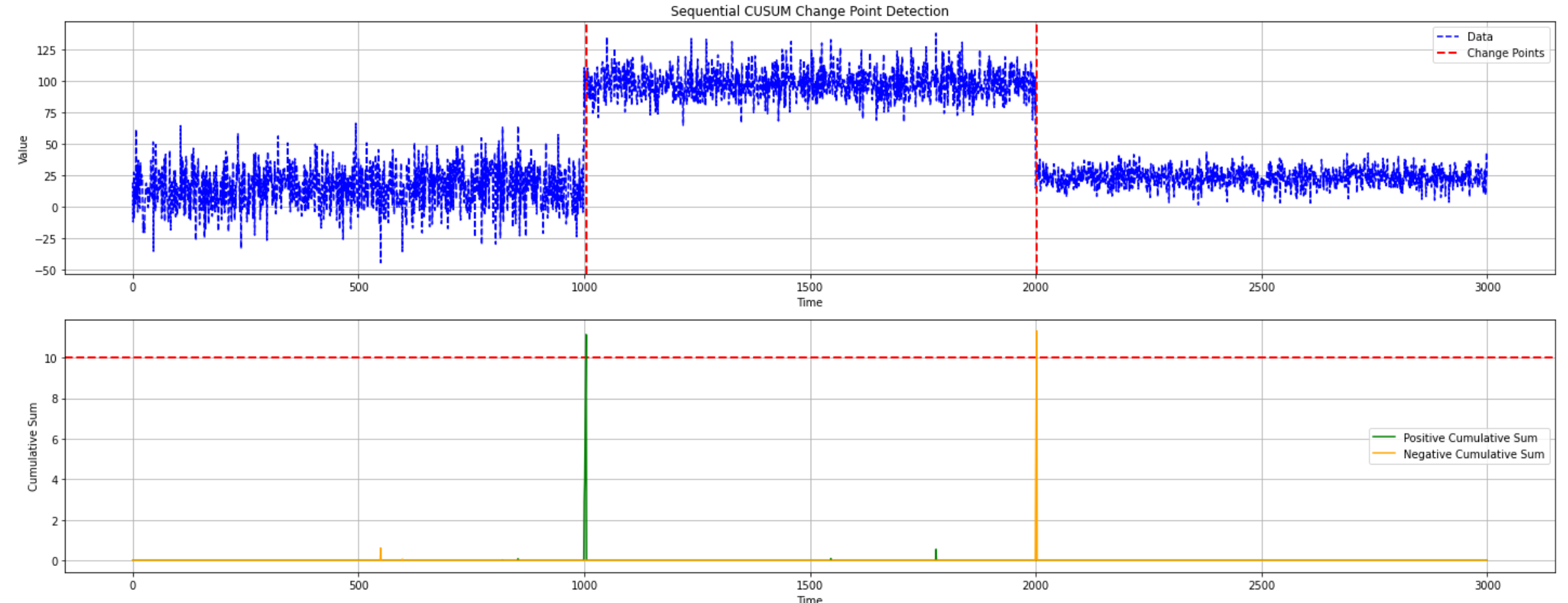
- plot_change_points(data: ndarray, change_points: list, pos_changes: list, neg_changes: list)
Plots data with detected change points and cumulative sums.
- Parameters:
data (numpy.ndarray) – Original data points.
change_points (list) – List of detected change points.
pos_changes (list) – List of positive cumulative sums.
neg_changes (list) – List of negative cumulative sums.
Examples
Instance-based Detection
from source.detector.cusum import CUSUM_Detector

detector = CUSUM_Detector(warmup_period=10, delta=10, threshold=20)
data_stream = np.concatenate([np.random.normal(0, 1, 100),
                    np.random.normal(5, 1, 100)])
for data in data_stream:
    pos, neg, is_change = detector.detection(data)
    print(f"Change Detected: {is_change} \n -Positives: {pos[0]}, \n -Negatives: {neg[0]}")
Batch-based Detection
from source.detector.cusum import CUSUM_Detector

detector = CUSUM_Detector(warmup_period=10, delta=10, threshold=20)
data = np.concatenate([np.random.normal(0, 1, 100),
                    np.random.normal(5, 1, 100)])
results = detector.offline_detection(data)
detector.plot_change_points(data,
                            results["change_points"],
                            results["pos_changes"],
                            results["neg_changes"])
Plotting