Kalman Filter
The Kalman Filter is a recursive algorithm used for estimating the state of a dynamic system from a series of noisy measurements. It is widely used in various applications, including navigation, control systems, and signal processing. The filter operates in two main steps: prediction and update. In the prediction step, the filter estimates the current state based on the previous state and a model of the system’s dynamics. In the update step, it incorporates new measurements to refine the estimate.
Kalman Filter class
- class source.smoother.incremental.KalmanFilter(F: ndarray, H: ndarray, Q: ndarray, R: ndarray)
Bases:
objectKalman Filter algorithm for filtering out noise in linear dynamical systems.
- Parameters:
F (np.ndarray) – State transition matrix of shape (n, n).
H (np.ndarray) – Observation matrix of shape (m, n).
Q (np.ndarray) – Process noise covariance matrix of shape (n, n).
R (np.ndarray) – Measurement noise covariance matrix of shape (m, m).
Initialize the KalmanFilter object.
- Parameters:
F (np.ndarray) – State transition matrix of shape (n, n).
H (np.ndarray) – Observation matrix of shape (m, n).
Q (np.ndarray) – Process noise covariance matrix of shape (n, n).
R (np.ndarray) – Measurement noise covariance matrix of shape (m, m).
- __init__(F: ndarray, H: ndarray, Q: ndarray, R: ndarray) None
Initialize the KalmanFilter object.
- Parameters:
F (np.ndarray) – State transition matrix of shape (n, n).
H (np.ndarray) – Observation matrix of shape (m, n).
Q (np.ndarray) – Process noise covariance matrix of shape (n, n).
R (np.ndarray) – Measurement noise covariance matrix of shape (m, m).
- fit(observations: list[ndarray]) list[ndarray]
Fit the filter to a set of observations.
- Parameters:
observations (list of np.ndarray) – List of observation vectors, each of shape (m,).
- Returns:
list_smooth – List of filtered state estimates after each observation.
- Return type:
list of np.ndarray
- update(observation: ndarray) None
Update the model with the new observation.
- Parameters:
observation (np.ndarray) – New observation vector of shape (m,).
Example Usage
import numpy as np
import matplotlib.pyplot as plt
from source.generator.change_point_generator import ChangePointGenerator
from source.smoother.incremental import KalmanFilter

# Generate time series data with change points
generator = ChangePointGenerator(num_segments=3,
                                  segment_length=1000,
                                  change_point_type='sudden_shift',
                                  seed=12)  # set seed for reproducibility
generator.generate_data()
observations = generator.get_data()

# create the model
F = np.array([[.8]])
H = np.array([[.8]])
Q = np.array([[.5]])
R = np.array([[.5]])
model = KalmanFilter(F=F, H=H, Q=Q, R=R)
list_filtered = []
# update the model with each observation
for observation in observations:
    model.update(np.array([observation]))
    list_filtered.append(model.state_estimate)

# plot the filtered values
plt.figure(figsize=(15, 4))
plt.plot(observations, label='Observations')
plt.plot(list_filtered, label='Kalman Filtered', color='orange')
plt.legend()
plt.show()
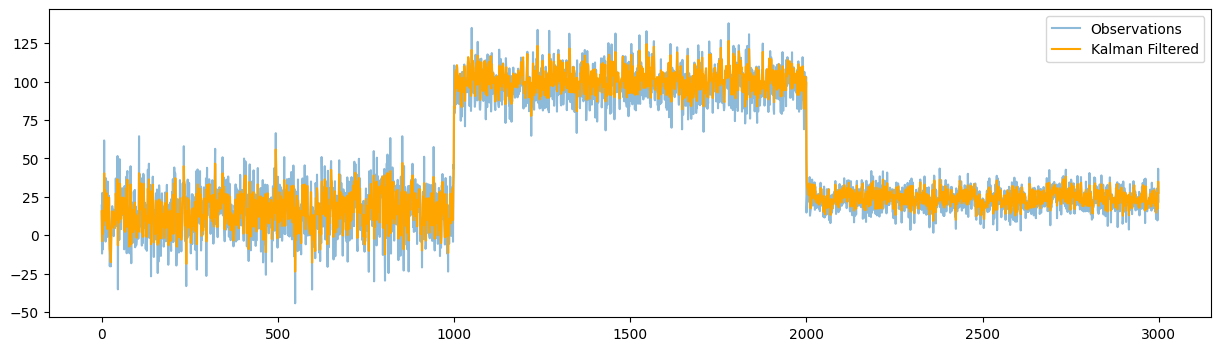
Plotting